
RIPLRT extends respiratory virus forecasting in Puerto Rico at ASM Microbe 2026
Presented at ASM Microbe 2026 in Washington, DC: fungal spores, but not pollen, provide a reproducible short-lead signal of RSV incidence across two health regions of Puerto Rico.
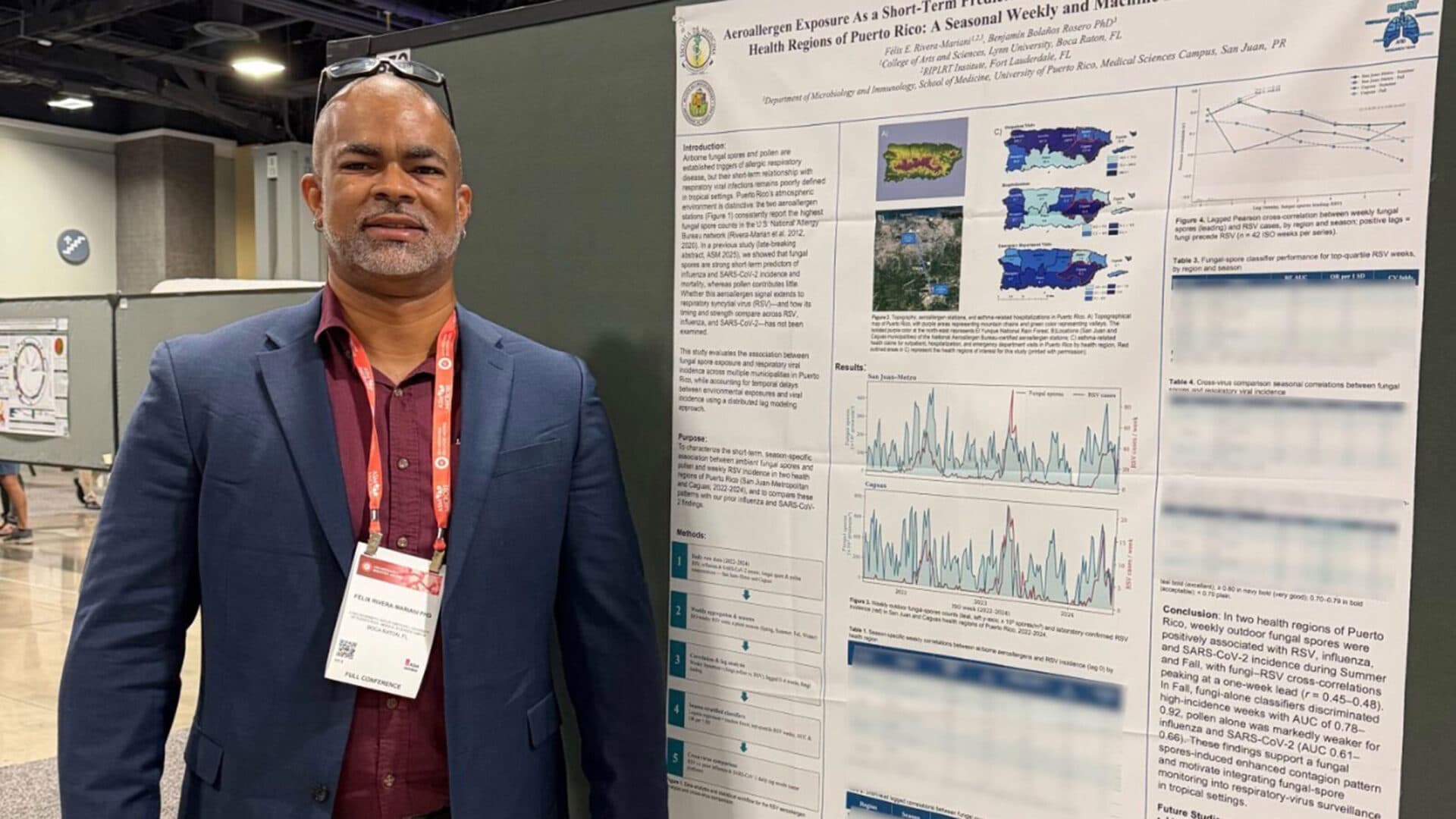
Dr. Félix E. Rivera-Mariani presented new collaborative research at ASM Microbe 2026 in Washington, DC, extending the Institute's work on using aeroallergen exposure to forecast respiratory viral activity in Puerto Rico.
The study, Aeroallergen Exposure as a Short-Term Predictor of RSV, Influenza, and COVID-19 in Two Health Regions of Puerto Rico: A Seasonal Weekly and Machine-Learning Analysis, combined weekly outdoor fungal-spore and pollen counts with surveillance data for respiratory syncytial virus (RSV), influenza, and COVID-19 across two health regions of the island.
Key finding: fungal spores, but not pollen, provided a reproducible short-lead signal of RSV incidence. In other words, rises in airborne spore concentrations preceded rises in RSV cases by a consistent interval, a pattern that held across seasons and modeling approaches.
Why it matters:
- Early warning. A short-lead environmental signal gives clinics and public-health agencies time to prepare for RSV surges.
- Surveillance. Routine aerobiological monitoring can complement case-based surveillance in resource-limited settings.
- Environmental health forecasting. The work connects exposure science, immunology, and machine learning, the core of RIPLRT's community-to-clinic-to-cloud approach.
The research is conducted with Dr. Benjamín Bolaños-Rosero (UPR Medical Sciences Campus) and RIPLRT mentees.
Adapted from Lynn University News.